Notes
Catering, Wi-Fi, de-icing and pets: the extras
Below the hourly rate sit the lines that make a trip comfortable, legal and sometimes possible at all. None should be a surprise, and on a good quote none is.
When people compare charter quotes, they tend to look at the total and the hourly rate. The lines in between, the extras, are where quotes most often differ and where travellers are most often caught out. Some are optional comforts, some are imposed by weather or law, and a few depend entirely on the aircraft. Here is how each one usually works.
Catering
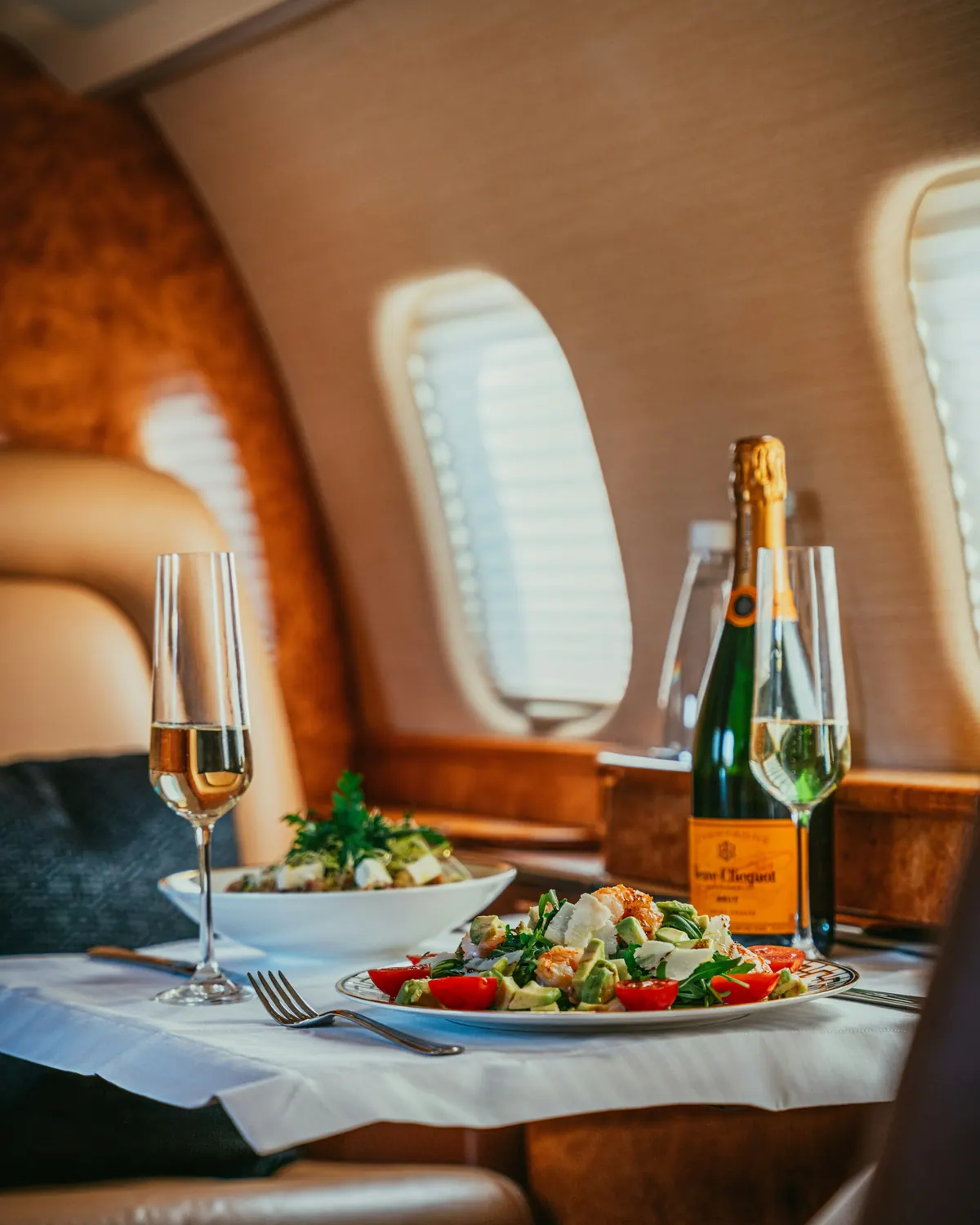
Most charter aircraft do not carry a kitchen in the sense that an airliner does. Food is ordered from a specialist aviation caterer or a restaurant near the departure airport, collected by the crew or the handler, and stowed on board. On larger aircraft with a full galley and a cabin attendant, meals can be plated and served properly; on light jets, catering is usually a well-made cold selection.
Catering is normally billed at the caterer's cost, sometimes with a handling charge, and it appears as its own line or is added afterwards. Two practical points matter more than the price: order early, because good caterers need notice, and state allergies and dietary needs clearly in writing. Simple snacks and drinks are often included as standard, but what counts as standard varies by operator, so ask.
Wi-Fi
Connectivity depends entirely on the aircraft. Some have no internet at all; some have systems that work over land within range of ground stations; some have satellite systems that work over oceans. Speeds range from enough for email to enough for video calls. Some operators include Wi-Fi in the price, others charge by the hour or by the amount of data used, and international roaming can be costly.
If you need to work in flight, say so in your request. It can change which aircraft we offer, and it avoids discovering at altitude that the system on board is not up to a video meeting.
De-icing
In winter, frost, snow or ice on the wings must be removed before take-off. De-icing fluid is sprayed by the ground handler and charged according to how much is used, which depends on the size of the aircraft and the weather on the day. On a large aircraft in heavy snow it can be a significant amount. Because nobody knows the weather in advance, de-icing is almost always listed as an estimate or as billed at cost, and it is the most common reason a final invoice differs from a quote on winter trips through places such as Aspen, Teterboro or Chicago.
Pets
Many operators welcome dogs and cats in the cabin, but each sets its own rules on size, number and whether the animal must stay in a carrier. Some add a cleaning fee. Allergies matter too: an operator may decline a pet on an aircraft that is booked for a passenger with allergies the next day. For international trips, animals need documentation such as vaccination records and health certificates issued within set time limits, and some countries require approval in advance. Mention pets in your first message, so that only aircraft that accept them are quoted.
| Extra | When it applies | How it is usually billed |
|---|---|---|
| Catering | Whenever you order food beyond the standard provisions | At the caterer's cost, sometimes with a handling charge |
| Wi-Fi | Aircraft with connectivity, when you use it | Included, per hour or by data, depending on operator |
| De-icing | Winter departures with frost, snow or ice | By the amount of fluid used; estimated in advance |
| Pets | When animals travel, with operator approval | Usually free; some operators add cleaning fees |
| Crew overnights | When the crew stays away from base | Hotel and expenses per night |
| Parking and hangar | When the aircraft waits, especially in winter | Per night, set by the airport or handler |
| International fees | Trips that cross a border | Customs, immigration, permits and foreign taxes |
Crew overnights, parking and hangars
When an aircraft waits for you somewhere other than its base, the crew needs somewhere to sleep and the aircraft needs somewhere to park. Crew overnight costs cover hotel rooms and expenses. Parking fees vary from modest to considerable at busy airports, and in very cold weather an operator may want the aircraft in a heated hangar overnight, which avoids de-icing in the morning but costs money of its own. On a multi-day trip it is worth asking whether it would be cheaper to send the aircraft home and bring it back.
Ground transport and other requests
Cars to and from the private terminal, flowers, specific newspapers, child seats or a particular wine are all possible. They are usually arranged through the operator or the handler and billed at cost. The rule is the same as for catering: the earlier you ask, the better the result.
International extras
Crossing a border brings its own charges: customs and immigration fees, sometimes landing permits, handling at airports that require it, and foreign passenger taxes. Some are fixed and appear on the quote; others depend on the exact time of arrival or the number of passengers. Your advisor will tell you which apply to your trip.
How extras appear on our quotes
Every quote we send separates the extras that are known from those that can only be estimated. Federal excise tax and segment fees on domestic trips, known airport charges and any catering you have ordered appear as lines in the total. De-icing, and anything else that depends on the day, is marked as an estimate with a note on how it will be billed. That way the number you agree to is as complete as it can honestly be.
Price your own trip
Send the route and dates for an itemised, all-in quote from a certificated operator.
Request a quote